Original Reality Theory
Aa
AI alignment protocol (in Portuguese)
2 Before Explaining the Theory
2.3 Nobody Knows Everything
A theory that spans different fields of knowledge faces an unavoidable difficulty before it even begins: no one can master, in depth, every specialty whose knowledge they will need to draw on.
Contemporary science has grown too vast to fit within a single mind. Physics, chemistry, biology, astronomy, neuroscience, psychology, anthropology, sociology, and many other fields branch into specialties that require years of training and, often, a lifetime of work. Even within a single discipline, specialists continually rely on findings produced by other specialists.
This is not a failure of science. It is a consequence of its development. Knowledge has grown through a division of cognitive labor: different people pursue different problems in depth, develop their own methods, test hypotheses, and produce findings that become part of a shared body of knowledge.
An integrative theory works in a different direction. Rather than delving ever deeper into a single specialty, it seeks relationships among findings from different specialties. These two operations are not equivalent and should not be confused.
Specialists increase resolution. They need to understand details that may be decisive within their domain: methods, calculations, controversies, experimental limitations, technical definitions, and the history of the problem within the field. An integrative inquiry often needs to move in the opposite direction: reduce resolution to compare structures, relationships, and findings across different domains.
Reducing resolution, however, does not mean becoming independent of the disciplines that produced those results. A conclusion used by ORT continues to belong to the field that produced it and remains limited by what that field actually allows us to state. Abstraction can remove details that are unnecessary to the question under analysis; it cannot add certainties that were absent from the original knowledge. This distinction can be summarized by a rule:
ORT may reduce resolution. It must not increase certainty.
Consider a map. To walk along a street, we need a scale at which streets, intersections, and buildings are visible. To understand the relationship between cities, that same resolution may become an obstacle: we need to pull back. In doing so, we lose details but gain relationships that were not perceptible when we were looking at a single corner. Neither scale is universally superior. The appropriate resolution depends on the question.
The question also determines which field responds. A bunch of grapes seems like a simple object. The farmer asks how to grow it; the agronomist, whether the plant is healthy; the chemist, what molecules the grapes are made of; the physicist, what atoms; the astronomer, how the elements that make them up were formed; the pastry chef, how they will taste in a tart. The grapes remain the same. What changes is the question, the analytical frame, and the representation each person constructs.
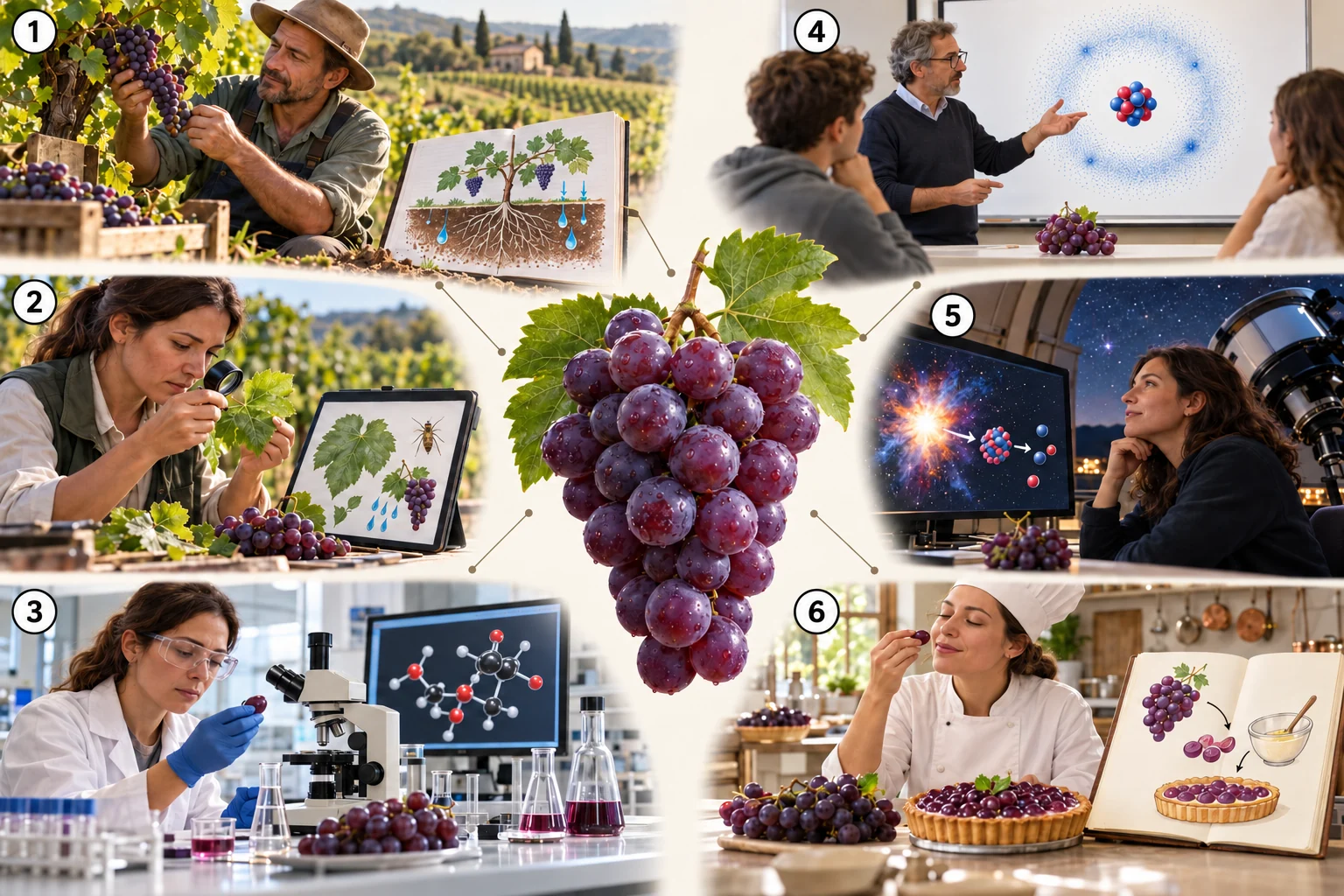
Those who relate these fields also adjust resolution to the question. We do not need to master all of population genetics to use a well-established conclusion about biological evolution, just as we do not need to reconstruct all of semiconductor physics to understand that computers depend on the physical properties of matter. But using a conclusion is not the same as mastering the entire mechanism that produced it.
This boundary matters because our own perception of knowledge can mislead us. Experiments in cognitive psychology have shown that people often believe they understand mechanisms much more deeply than they can demonstrate when required to explain them in detail. This phenomenon became known as the illusion of explanatory depth. Understanding a clear description, recognizing the terms used, or following an explanation without difficulty can produce a sense of mastery that disappears when we have to reconstruct the mechanism.
There is a related risk: processing fluency can be mistaken for learning or understanding. A fluent explanation seems more comprehensible, and technologies capable of providing immediate answers make this impression especially relevant. Today it is possible to move through physics, biology, psychology, and sociology in a few minutes, receiving a coherent explanation at each stage. The speed of the journey does not, by itself, turn this sequence into mastery of the disciplines traversed. ORT must explicitly recognize this risk.
But acknowledging the risk does not mean that every inquiry across disciplines is necessarily superficial. Scientific work itself depends on different levels of expertise and epistemic dependence. A researcher may understand findings from another specialty well enough to use them without having the expertise required to make a technical contribution to that field. No individual mind personally reconstructs the entire chain of knowledge on which it depends.
The problem, then, is not reliance on knowledge produced by others. The problem is losing sight of the limits of that reliance.
Legitimate integration requires knowing what is being brought in. It requires distinguishing a widely established finding from a disputed hypothesis, an explanation intended for teaching from a technical conclusion, an analogy from a structural equivalence, and one’s own inference from what the original discipline has actually demonstrated.
Finding similar words in different fields is not enough. “Relation,” “information,” “energy,” “organization,” and “system” can appear in many fields without meaning exactly the same thing. Similar wording may suggest a line of inquiry; it cannot serve as proof of the relationship one seeks to establish.
For this reason, interdisciplinarity is not simply juxtaposition. Placing a conclusion from physics alongside one from biology and another from sociology does not automatically produce a broader understanding. It is necessary to show what is being compared, at what level of abstraction, which properties remain relevant after resolution is reduced, and which differences must not be erased.
This care produces a movement that is not simply one of pulling back. An inquiry may begin within a specialty, use a result, increase abstraction, and compare it with results from other fields. If that comparison yields a conclusion whose validity depends on a specialized detail, it is necessary to return: increase resolution again, consult the relevant technical knowledge, and check whether the proposed relationship still holds. The movement can be represented as follows:
specialty → finding → abstraction → integration → doubt → return to the specialty → verification → renewed integration.
There is no final point at which a general inquiry becomes independent of the specialties. It continually depends on them.
This also sets a boundary of responsibility for ORT. When a proposition requires technical expertise beyond what is available, the appropriate response is not to fill the gap with rhetorical confidence. It is to acknowledge the limit, seek specialized literature, turn to calculations, experiments, data, or specialists when necessary, and keep the conclusion provisional until verification is available.
The goal of an integrative theory is not to replace physics, chemistry, biology, psychology, or any other discipline. It is to seek relationships that may remain invisible when each field is viewed in isolation and to test whether those relationships hold up when revisited in light of the specialized knowledge from which they arose.
This allows us to distinguish two different kinds of depth. There is the vertical depth of someone who delves into a specialized problem. And there is relational depth, produced when results from different fields are brought into contact and reveal structures that would not be visible within a single discipline. One does not replace the other. The second is possible only because the first exists.
Readers therefore do not need to accept in advance that ORT’s abstractions are legitimate. They can test them. They can ask whether the theory attributes something to a discipline that it has not demonstrated, erases a necessary difference to make two structures appear identical, turns an analogy into an identity, or increases certainty while reducing resolution. If that happens, abstraction has failed. The function of this method is not to shield ORT from these criticisms. It is to make them possible.
A theory that aims to cross different domains of knowledge must accept that each crossing can be retraced in the opposite direction. Integration becomes stronger not by distancing itself from the specialties, but by being able to return to them without contradicting the knowledge it used as its starting point.
Summary for Reflection
- ORT may reduce resolution. It must not increase certainty.
- The appropriate resolution depends on the question.
- An imported conclusion remains limited by the field that produced it.
- Similarity between words does not prove a relationship between phenomena.
- Integration gains strength when it returns to the specialties without contradicting them.
The entire theory on a single pageContinuous reading for people and AI tools.